Everything you need to start birding.
Binoculars, apps, field guides, where to go, and how to be a good neighbor to the birds. Start wherever you like.
Binoculars
You don't need expensive gear to start. A decent pair of binoculars will change how much you see, and you can borrow a pair before you buy.
What to look for
- Comfort. Choose a pair that feels good in your hands and isn't too heavy to carry all morning.
- Get a harness. A binocular harness spreads the weight across your shoulders instead of your neck and keeps them from swinging when you walk. It clips onto the strap lugs and makes a long morning a lot more comfortable.
- Waterproof and fog-proof. Worth it in Florida's humidity and afternoon storms.
- Close focus. Lets you focus on birds, butterflies, and dragonflies just a few feet away.
- Eye relief. If you wear glasses, look for long eye relief and eyecups that twist down.
- Try before you buy. Test a few pairs in person, or try a friend's on one of our field trips.
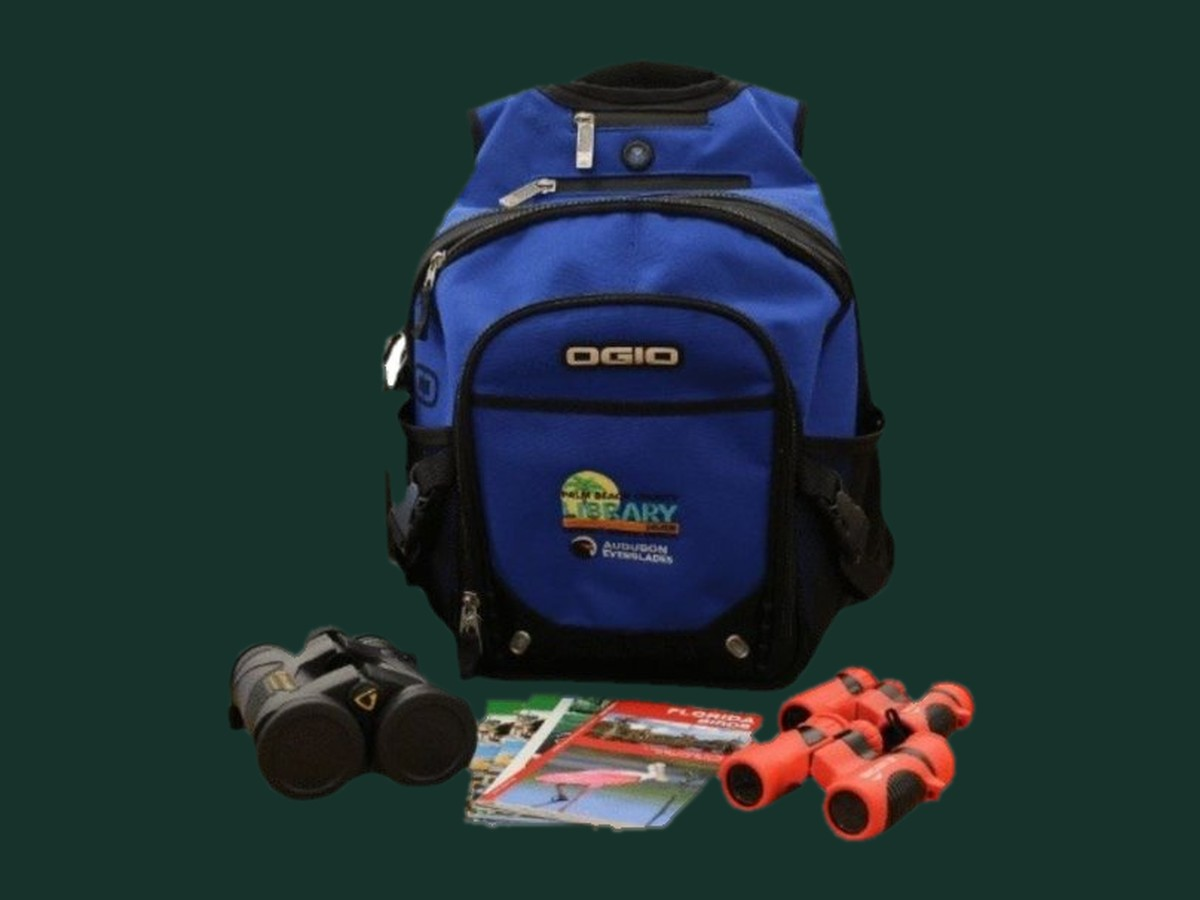
No binoculars? Borrow our birding backpack.
Our birding backpacks are available to check out through the Palm Beach County Library System. Each one includes:
- 1 pair of adult binoculars
- 2 pairs of children's binoculars
- 1 Florida Birds Pocket Guide
- Supplemental birding materials
They're popular, so place a hold a few weeks ahead. We also often have loaner binoculars on our field trips.
Place a holdKnow your binoculars
- Objective lensThe big lens at the front. It gathers the light, and its width in millimeters is the second number, the 42.
- BarrelHolds the prisms and lenses. Rubber armor gives you grip and protects them from bumps.
- HingeFold the barrels in or out until the two circles you see become one.
- Focus wheelRoll it with your finger to bring the bird into sharp focus.
- DiopterA ring on one eyepiece that makes up for the difference between your two eyes. Set it once and leave it.
- EyepieceThe small lens you look through, also called the ocular lens.
- EyecupTwist up if you don't wear glasses. Twist down if you do.
- Strap lugWhere the neck strap or harness clips on.
Setting the diopter: Look at something far away. Close your right eye and turn the focus wheel until it's sharp. Then close your left eye and turn the diopter ring until it's sharp for your right eye too.
What’s a spotting scope?
A spotting scope is a single-barrel telescope that sits on a tripod. Where binoculars magnify 7 or 8 times, most scopes zoom from about 20 to 60 times. That’s what lets you pick out a sandpiper on a far mudflat, count ducks across a lake, or see the band on a shorebird’s leg.
You don’t need one to start. Binoculars first, always. A scope is for when you find yourself wishing the birds were closer, especially at the beach, the lakes, and the big open marshes.
- Angled or straightAn angled eyepiece is easier to share with people of different heights and to look up into trees. A straight one is quicker for finding a bird.
- Objective lensUsually 60 to 85 mm. Bigger is brighter but heavier.
- TripodA steady tripod matters as much as the scope. At 60 times, every wobble shows.
- DigiscopingHold your phone camera up to the eyepiece, or use an adapter, and you can take photos through the scope.
Try one first: if someone on a field trip sets up a scope, ask for a look. Birders love to share the view.
Field guides & checklists
A good field guide helps you learn to look at a bird's shape, markings, and behavior, not just its color.
Popular field guides
- The Sibley Guide to Birds by David Sibley
- National Geographic Field Guide to the Birds of North America
- Kaufman Field Guide to Birds of North America
- Peterson Field Guide to Birds of Eastern and Central North America
Most come in eastern editions, which are lighter and cover just the birds you'll see in Florida.
Palm Beach County Checklist of Birds
Our county checklist, compiled by longtime local birder Brian Hope, lists every species confirmed in Palm Beach County going back to the 1950s. Only birds seen by multiple observers or documented with photos or video made the list.
"I was the first to bird on a regular basis in Spanish River Park, Belle Glade Marina, and Wakodahatchee." — Brian Hope
Download the checklist (PDF)Apps that help
Your phone can be one of your best birding tools. All of these are free.
Merlin Bird ID
From the Cornell Lab of Ornithology. Answer a few questions, snap a photo, or record a song and Merlin suggests what you saw or heard. Sound ID works even before you spot the bird.
merlin.allaboutbirds.org →eBird
Also from the Cornell Lab. Keep checklists of the birds you see, track your life list, and find out what's being seen nearby. Every checklist becomes data scientists use.
ebird.org →Audubon Bird Guide
National Audubon's field guide app, with photos, songs, and range maps for more than 800 North American species.
audubon.org/app →iNaturalist & Seek
Photograph any plant or animal, get help identifying it, and share your observation with scientists and naturalists around the world. Seek, its family-friendly sister app, identifies what you point your camera at, with no account needed. Great for kids.
inaturalist.org →Where to go
This isn’t a complete list. It’s a few favorite places to start, from national wildlife refuges to neighborhood city parks. Tap a name to visit its website. Early mornings are best, and winter brings the most variety.
National parks, refuges & public lands
- Arthur R. Marshall Loxahatchee National Wildlife RefugeBoynton BeachThe northern Everglades, with marsh trails and a cypress swamp boardwalk.
- Jupiter Inlet Lighthouse Outstanding Natural AreaJupiterFederal land around the lighthouse, with coastal scrub and mangroves where migrants stop over in spring and fall.
- Everglades National ParkHomesteadWorth the drive to our namesake. The Anhinga Trail boardwalk puts you close to wading birds, Anhingas, and alligators.
Find more: National parks in Florida · National wildlife refuges
State parks & wildlife areas
- John D. MacArthur Beach State ParkNorth Palm BeachBeach, dunes, and lagoon in one place, with shorebirds and coastal hammock birds.
- Jonathan Dickinson State ParkHobe SoundJust over the county line. Sand pine scrub, pine flatwoods, and the Loxahatchee River, with a chance at Florida Scrub-Jays.
- J.W. Corbett Wildlife Management AreaLoxahatcheePine flatwoods and wet prairie, home to woodpeckers, sparrows, and more.
Find more: Florida State Parks · FWC wildlife management areas
Palm Beach County parks
- Wakodahatchee WetlandsDelray BeachA boardwalk over treated-water wetlands, with wading birds nesting right beside the rail.
- Green Cay Nature Center & WetlandsBoynton BeachA long boardwalk through marsh, great for herons, ducks, and Purple Gallinules.
Find more: Palm Beach County Parks & Recreation
Palm Beach County Natural Areas
The county manages more than 30 natural areas, from coastal scrub to cypress sloughs. Most have parking, marked trails, and are free and open sunrise to sunset. A few good ones for birding:
- Frenchman’s ForestPalm Beach GardensHammock, pine flatwoods, and wetlands, with a boardwalk through the forest.
- Loxahatchee SloughPalm Beach GardensHeadwaters of the Loxahatchee River. Cypress, marsh, and pine, with a boardwalk out into the slough.
- Pine GladesJupiter FarmsCypress swamp, wet prairie, and slash pine, with more than seven miles of trails and an observation platform. Look for Sandhill Cranes, Snail Kites, and Eastern Meadowlarks.
- Winding WatersWest Palm BeachWetlands with a boardwalk and observation platform. Look for Wood Storks, Roseate Spoonbills, and whistling ducks.
- Snook IslandsLake Worth BeachRestored mangrove islands in the Lake Worth Lagoon, with a boardwalk over the water.
- Juno DunesJuno BeachStretches from the ocean to the Intracoastal, with beach dunes, Florida scrub, and coastal hammock.
- Delray OaksDelray BeachAn oak hammock in the middle of the city, worth a look during spring and fall migration.
Some sites don’t have parking or accessible trails, so check before you go.
Learn more about Palm Beach County Natural AreasCity parks & preserves
- Grassy Waters PreserveWest Palm BeachThe city’s protected wetland, with trails and a boardwalk, and a chance at Snail Kites.
- Spanish River ParkBoca RatonShady coastal hammock that can fill with warblers during migration.
Many cities have their own nature parks and preserves. Check your city’s parks department to find one near you.
The Great Florida Birding & Wildlife Trail
The Birding Trail isn’t one path. It’s a statewide network of more than 500 places to see birds and wildlife, from big wilderness areas to small city parks. It started as a Florida Audubon idea and is run today by the Florida Fish and Wildlife Conservation Commission (FWC).
Each site has its own page with directions, habitats, what you might see, and what’s there, like trails, restrooms, or an observation platform. Several of the places on this page are on the Trail, including Winding Waters and Pine Glades.
Explore the Birding Trail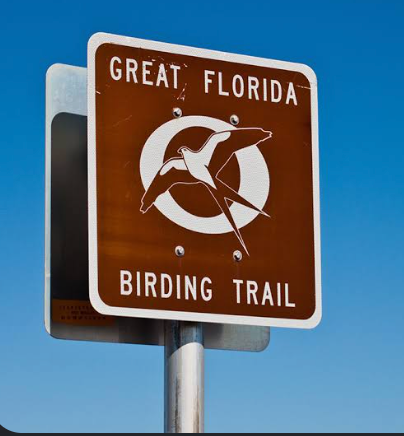 Look for this sign at Trail sites.
What to wear & trail safety
Florida birding is easy to love and easy to underestimate. Dress for sun, bugs, and wet feet, and you’ll enjoy the morning a lot more.
What to wear
- Light layers. Long sleeves and long pants block sun, bugs, and scratchy plants. Winter mornings can start out chilly.
- A wide-brimmed hat. The sun is strong here, even in January.
- Closed-toe shoes. Wear a pair you don’t mind getting wet or muddy. Trails can flood after a rain.
- Muted colors. Greens, tans, and browns help you blend in so birds stay put.
- A rain jacket. Summer showers pop up fast.
What to bring
- Water, more than you think you’ll need.
- Sunscreen and bug spray.
- A snack.
- A charged phone. Service can be spotty in remote areas, so download a map before you go.
- Binoculars and a field guide or app.
Stay safe out there
- Watch the weatherSummer storms build fast in the afternoon. Go early to beat the heat and the lightning, and if you hear thunder, head back to the car.
- Give alligators roomKeep your distance and never feed them. It’s illegal in Florida and teaches them to come to people. Keep kids and pets back from the water’s edge.
- Watch your stepFlorida has venomous snakes, including rattlesnakes and cottonmouths. Look before you step or reach, and let snakes move along. Watch for fire ant mounds, too.
- Stay on the trailIt protects habitat and keeps you out of poison ivy and thick brush. Check yourself for ticks when you get home.
- Tell someone your planLet a friend know where you’re going and when you’ll be back, especially if you’re heading somewhere remote.
- Know the hunting seasonsSome wildlife management areas, like J.W. Corbett, are open to hunting at certain times of year. Check FWC’s hunt dates before you go and wear bright orange during hunting season.
Birding ethics
The birds come first. A few simple habits keep birds safe and keep birding welcoming for everyone.
Give birds space
If a bird changes what it's doing because of you, you're too close. Back off, especially around nests and roosts.
Go easy on playback
Playing recorded calls can stress birds and pull them away from nests. Skip it during nesting season and around threatened species.
Respect posted areas
Stay out of roped-off nesting areas on beaches and rooftops, and stick to trails and boardwalks.
Don't feed wildlife
Feeding wild birds, including ducks and pelicans, changes their behavior and can make them sick.
Share sightings wisely
Keep the locations of nests, owls, and rare or sensitive species off social media.
Leave it better
Leash your dog, pack out trash, and pick up fishing line and hooks you find.
Read the full American Birding Association Code of Birding Ethics.
Ready to give it a try?
Our Become a Bird Nerd series is made for beginners, and our field trips are a friendly way to learn from experienced birders.
Become a Bird NerdFind a field trip